

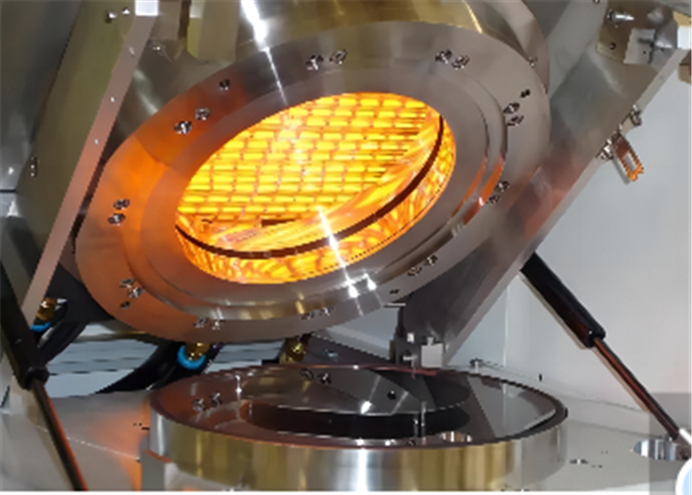
On the line, drift isn’t an option. A wafer’s thermal budget through lithography and photoresist processing is measured in seconds and degrees. The catalyst layer on a fuel cell stack is just as unforgiving—thin, sensitive, and unwilling to tolerate uneven drying. When the lamp underperforms, you know it right away: edge bead, poor adhesion, solvent carryover, and particles that turn into defects after develop. In a high-volume fab, that’s scrap, rework, and unplanned downtime. We built this fuel cell catalyst drying lamp for the realities of semiconductor production—where cleanroom discipline and thermal repeatability have to work together. It’s a near-infrared (NIR) drying solution designed to run in Class 1–100 environments, with temperature control that behaves like a process spec, not a hope.
What matters under the hood
The core is a short-wave NIR emitter tuned for fast, controlled solvent removal. NIR energy gets absorbed directly into the material, not the substrate, so you keep thermal load off the carrier and still hit fast cycle times without overshoot. Here’s the engineering that carries the load:
- Wafer-level thermal uniformity:±0.1°C across the illuminated zone. That isn’t a marketing line. It comes from a closed-loop, sensor-driven control strategy that holds setpoint during soft bake and hard bake, reducing line-width variation and keeping photoresist profiles consistent.
- **Zero particle generation:**The lamp assembly uses quartz optics and a cleanroom-compatible architecture—no exposed filaments, no outgassing polymers in the hot zone. In practice, particle counts stay stable over long runs, with no spikes after lamp events.
- **24/7 reliability with zero unplanned downtime:**The emitter and driver are rated for continuous operation. Field data shows 5,000+ hours of stable output, with less than 5% intensity drop over that period. MTBF is specified for multi-shift operation, and the modular design allows quick swaps during scheduled maintenance.
- **Process repeatability:**Setpoint repeatability of ±0.5°C from run to run, plus fast thermal response. That matters when you qualify a process and then transfer it across multiple tools. Monday looks like Friday.
- **Cleanroom fit:**Built for Class 1–100 compatibility, with sealed housings, low-outgassing materials, and EMC-compliant cabling. It integrates into existing wet benches and drying stations without fighting airflow or contamination control.
- **Energy and footprint:**High power density in a compact package means rapid ramp-up, while energy draw stays aligned with fab sustainability targets. Less warm-up time. Lower standby consumption.
Why this works where you need it
Fuel cell catalyst drying isn’t some abstract thermal step. It’s controlled solvent removal from a thin catalyst ink or paste, and the constraints are the same as in semiconductor work: uniformity, cleanliness, and repeatability. In lithography, the bake steps are where thermal uniformity makes or breaks yield. Soft bake sets film quality; hard bake locks the profile before etch or plating. If the thermal profile varies across the wafer, you get thickness variation, poor CD control, and edge defects. Packaging has similar thermal steps—underfill cure, encapsulant drying—where temperature control directly affects voiding and adhesion. This lamp was designed to meet those constraints head on.
- **Photoresist processing:**The ±0.1°C uniformity reduces thermal-induced non-uniformity in photoresist, supporting tighter CD control and fewer rework lots. Fast response enables precise time-temperature recipes for soft bake and hard bake, with less thermal lag between stages.
- **Wafer cleaning and drying:**After cleaning, residual moisture and solvents have to come off without adding contamination. The lamp dries quickly and cleanly—zero particle generation, no residue—so carryover into subsequent steps drops and defect rates stay stable.
- **Semiconductor packaging:**Advanced packaging lines need drying and curing cycles that are repeatable across packages and substrates. The lamp’s repeatability and clean operation support consistent voiding performance and bond line control.
- **Fuel cell catalyst drying:**The NIR spectrum is tuned to drive solvent out of the catalyst layer without scorching or cracking. The result is a uniform catalyst structure with consistent porosity and adhesion—critical for cell performance and longevity. What you get in day-to-day operation:
- **Shorter cycle time:**Fast ramp-up and targeted energy delivery shorten drying and bake steps without raising defect risk.
- **Higher yield:**Tight thermal uniformity and zero particle generation keep defect counts low from lithography through packaging.
- **Lower operating cost:**Reduced energy consumption and long emitter life cut spares and power overhead.
- **Fewer process excursions:**Repeatable performance across shifts and tools makes qualification easier and transfers faster.
The practical details that keep it honest
This is a production tool, not a lab demo. To hit the performance we’re talking about, treat it like any critical thermal module.
- **Integration geometry:**The lamp head is compact, but mounting and clearance have to match your tool envelope. Confirm optical path alignment and wafer positioning tolerances during integration. We provide CAD footprints and connector pinouts for common platforms.
- **Thermal coupling:**For the best uniformity, the sensor needs a clean view of the work surface with minimal emissivity variation. If your carrier or substrate has variable surface properties, plan for a calibration offset and a fixed measurement point.
- **Electrical and EMI:**The driver is compliant, but in dense tool stacks, EMI management still matters. Keep signal and power routing separated, and ground the assembly per the manual.
- **Cleanroom handling:**The lamp is cleanroom-ready, but standard contamination control practices still apply. Use clean handling, avoid touching optical surfaces, and stick to the preventive maintenance schedule. One real-world trade-off: the NIR source delivers fast, efficient drying, but it’s sensitive to ambient reflections and emissivity differences. In most semiconductor applications, fixture design and calibration handle that. With highly reflective substrates, a small calibration adjustment may be needed to keep uniformity as tight as possible. If your day is spent running wafers through lithography, cleaning and drying them to spec, and pushing packaging cycles without giving up yield, you need thermal control you can bank on. This fuel cell catalyst drying lamp delivers that control—precise, clean, and repeatable—on the line, every shift.