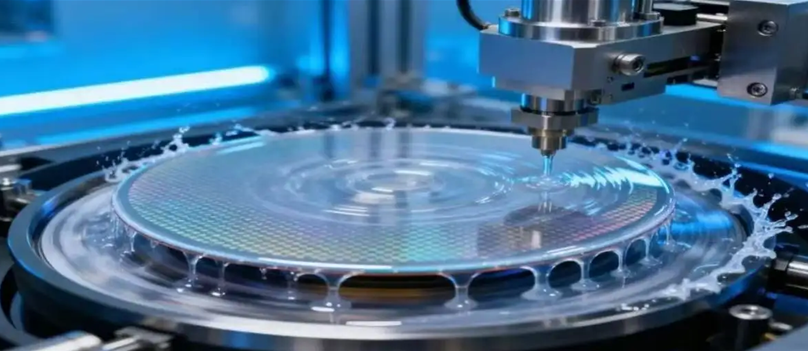
On the 300mm line, the photoresist bake is where you either spend your thermal budget wisely or waste it. Poor uniformity shows up fast as linewidth variation across the wafer. And if outgassing or particle generation contaminates the process, you’re looking at rework. You need a heat source that holds temperature steady, shot after shot, without making you fight the cleanroom. What matters under the hood We run molybdenum support infrared lamps—high-emissivity molybdenum filaments inside a quartz envelope tuned for short-wave infrared. The spectrum lines up with photoresist absorption, so you drive solvent removal quickly while the substrate surface stays stable. Across the bake zone, temperature uniformity holds within ±0.1°C, and repeatability is better than ±0.2°C shot-to-shot. The molybdenum support structure keeps its geometry under thermal load, so you don’t get hot spots or cold edges. Output stays stable over 5,000+ hours, with less than 5% intensity drift. The lamp body is built for Class 1–100 cleanroom operation and generates zero particles in steady-state. Why this matters in lithography Soft bake and hard bake set the critical dimensions. With this lamp, you hit target temperature faster, hold it without overshoot, and cut the variability in solvent residual. That shows up as tighter CD control, fewer defocused shots, and less scrap. Energy use drops because the response is immediate and dwell time is shorter. Reliability improves too—fewer unplanned downtime events from lamp swaps—and you widen the process window without rewriting recipes. A few practical notes Installation comes down to polarity and coolant flow. If those are off, lamp life drops and uniformity drifts. The lamp works with standard 24V control signals and common OEM interfaces, but you still need to verify reflector alignment on the first setup. Expect a warm-up period to reach thermal equilibrium, and after a lamp replacement, recalibrate the bake chamber to keep that ±0.1°C spec intact.